


House Prices v OCR: What History Actually Shows
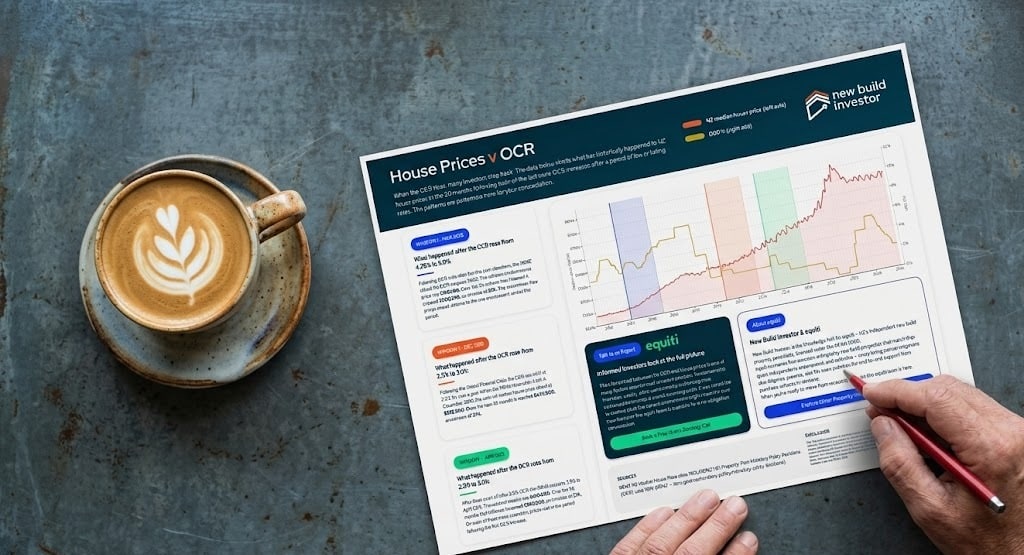
When the OCR rises, many investors step back. This free one-page analysis charts what has historically happened to NZ house prices following three OCR increases that each came after a period of low or falling rates. The patterns are presented for your consideration.
Who Is This Analysis For?
This analysis is for Kiwi property investors and homeowners who want to make informed decisions rather than reactive ones. When interest rates move, headlines tend to follow — and many investors pause or step back based on instinct rather than evidence.
This one-page guide is for people who prefer to look at the data. It charts what actually happened to NZ median house prices in the 36 months following three specific OCR increases, each of which came after a prolonged period of low or falling rates. If you want to understand how rates and house prices have interacted historically before forming your own view, this is for you.
Who Designed This Playbook?
This analysis was produced by New Build Investor, a digital knowledge hub powered by equiti, NZ’s independent new build property specialists, licensed under the REAA 2008.
The data is sourced from REINZ HPI Reports (median house price) and the Reserve Bank of New Zealand (OCR decisions). The analysis does not constitute financial advice. It presents historical data for reference purposes only, and all readers are encouraged to seek independent professional advice before making any investment decision.
Our 3 Step Proven Process
Call
Discovery Call
How-To Meeting
Asset Selection
The numbers speak for themselves
$#####
in Retail Sales
##
Years in Business
###+
Team Nationwide
Other Great Resources
The Retirement Riddle Guide
Download the guide and learn how you can take advantage of the equity in your home to build your retirement nest egg through verified and secure new build investment homes.
What Type of Property Should You Buy?
Take our assessment to help you identify the ideal type of property investment based on your unique goals, risk appetite, and personal strengths.
Designed to help you understand your next investment property purchase in just a few minutes you’ll have a clear picture of the investment path that best suits your profile.
How Much Could You Borrow?
Use our Usable Equity Calculator to see how you can leverage your existing home to build a property portfolio.
Frequently Asked Questions
Does a rising OCR mean house prices will fall?
Not necessarily. This analysis charts three occasions in recent NZ history when the OCR rose following a period of low or falling rates. On each of those occasions, median house prices increased over the following 36 months. The relationship between the OCR and house prices is influenced by many factors, and past patterns are not indicative of future results.
Does the OCR directly control mortgage rates?
Not directly. The OCR is the rate at which commercial banks borrow from the Reserve Bank overnight. Banks then set their own mortgage rates based on the OCR, funding costs, competition and other factors. When the OCR moves, mortgage rates tend to follow, but not always immediately, and not always by the same amount.
Why do investors worry when interest rates rise?
Higher rates increase the cost of borrowing, which can affect serviceability and reduce the pool of active buyers. This has historically led some investors to pause or exit the market during rate rises. Whether that response is warranted depends on a range of factors beyond the rate movement itself.
Have NZ house prices ever fallen significantly?
Yes. The most notable recent example was 2022 to 2023, when the national median price fell from a peak of around $925,000 in late 2021 to approximately $779,000 by mid-2023 — a decline of around 16%. That period coincided with one of the most aggressive OCR tightening cycles in NZ history, with the OCR rising from 0.25% to 5.5% in less than two years. Context matters when interpreting any rate movement.
What is the relationship between the OCR and inflation?
The RBNZ uses the OCR as its primary tool to manage inflation. When inflation is high, the RBNZ typically raises the OCR to reduce spending and borrowing. When inflation is low or the economy is slowing, it tends to cut the OCR to stimulate activity. Property investors watch the OCR closely because it signals the RBNZ’s view of the economic environment.
Do falling interest rates always push house prices up?
Not automatically. Falling rates reduce the cost of borrowing, which can increase buyer activity and support prices. However, the relationship is not linear. Prices are also influenced by housing supply, migration, employment, lending conditions, and consumer confidence. The 2009 to 2010 period is an example where rates fell sharply but prices remained relatively flat for a period before rising.
Testimonials
A massive thank you to Hamish (and Jordan) for supporting us (very patiently!) with the purchase of our investment property. We have appreciated your great comms throughout, your honesty, humour and dedication to help us onto the investment ladder.
Hamish and Equiti made our property buying process seamless. They aided in finding the right new build for our portfolio from a reliable developer. Their expertise and dedication were top-notch. Highly recommend!
Hamish and the team demonstrated exceptional knowledge in property investment and were incredibly professional and communicative throughout the entire process. They were attentive to my needs, showed genuine care guiding me meticulously through every step, I am extremely satisfied with the service I received and would highly recommend
Working with Hamish and the team at equiti was a fantastic experience. He responded quickly to all of our queries and ensured nothing was ever a problem. Thanks to their dedication and expertise we secured a great deal. Better than going direct to the developer. Highly recommend!
We had a brilliant experience navigating the purchase of our first investment property. Given we were novices, they gave us a great understanding of the things we needed to consider before making a decision and was very responsive when we had questions. We really appreciated the honesty and transparency that Hamish and the team provided throughout the process.
equiti made the process of purchasing our investment property simple and stress-free. Hamish’s regular check-ins, willingness to share his time and expertise, and proactive support were invaluable. When an unexpected change arose just before going unconditional, Hamish helped us promptly and proactively find a solution that exceeded our expectations. We’ve been very happy with the level of service and follow-up afterwards.
Buying an investment property was a new experience for Gary and I and also a very scary one. However, your professional manner and knowledge shone through. I would certainly not hesitate to recommend you to my friends or family. Surrounding myself with good people like you is the one recommendation I would give to others who were interested in buying an investment property. Thank you again, and I hope to work with you in the future
I recently bought my first investment property through equiti and worked with Hamish throughout. He provided excellent advice, great service, and made the whole process stress-free. I was able to leverage equiti’s strong relationships with developers and builders, securing the best deal and making things much easier than going direct. I wouldn’t hesitate to recommend Hamish and the team, and I’ll definitely work with them again.
H2 Title
Lorem ipsum dolor sit amet, consectetuer adipiscing elit, sed diam nonummy nibh euismod tincidunt ut laoreet dolore magna aliquam erat volutpat.